
My precious cat, Violet, died on September 19, 2026.
Writing about what happened to my cat during their last days helps me process my grief.
Violet was a mom cat that we rescued from our yard in 2014 (along with her kittens), and you can read more about that in her “How We Got Her” story.
At the time of her passing, she was at least 14. We had her for twelve years. We have pictures of her a couple of years before we took her in when she was spotted outside (presumably before she was abandoned by her previous owner).
Violet was a wonderful cat. She often followed me around, and I was by far her preferred human.
Violet’s Decline (Kind of)
Violet had struggled with IBS symptoms for the last couple of years. For the last few months, she had been on steroids, as they helped her manage the issues best.
We had tried the special diet hydrolyzed food a while back, and she had NO improvement from that after eating it for a few months.
However, she and a couple of the other cats lost weight on that diet, so we switched her back to regular food (with the vet’s approval).
Earlier this year, Violet had her teeth cleaned. During that process, the vet discovered that some teeth needed to be removed. One was super bad and had an infection around it.
So we got through all of that, and she seemed to be doing okay. Maybe some decline, but she seemed stable enough.
The Abscess by her Jaw
In July, she developed an abscess near her lower jaw on the side where the teeth had been removed.
Of course, I didn’t know that was the issue when it happened. She had stopped eating and was acting very lethargic.
I thought she was dying right then. We rushed her to the urgent care vet (which is more like a walk-in vet than an ER vet).
They said she’s not dying; she’s just sick! I was so happy.
After a checkup with her regular vet, she was put on antibiotics for 30 days.
And she seemed to recover just fine. And I kept checking her neck occasionally to make sure she was not getting another abscess.

Violet’s Final Days
It seemed like Violet wasn’t eating, or not eating as much.
Since the cats can graze dry food whenever they want, sometimes it’s hard to know for sure, as they could be eating and I just don’t see them.
Violet had gained weight from the steroids, so she actually looked pretty good for a cat her age dealing with ongoing IBS.
And on the day before her last day, my husband had friends over, so I didn’t see Violet much that day. But she didn’t want to eat treats that evening.
She was active enough, though, and not acting lethargic.
On Saturday morning, she ate a little bit of wet food. A little bit was all she normally ate of the morning wet food, so I was not really concerned.
When we returned from shopping, she didn’t come to see me, which was a little unusual, but I wasn’t that concerned yet.
Then, I gave her a dose of liquid steroids, and she made a weird gulping noise when she swallowed it. Then I was very concerned. I offered her a meat tube treat and dry crunchy treats, and she refused both. That’s when I realized she needed to be seen ASAP. I also thought her throat area felt a little puffy, but not in the same way that the abscess felt. I knew something was wrong, but didn’t know what.
The regular vet was already closed for the day. I called the urgent care vet. They were closing in a couple of hours and recommended an emergency vet.
The Emergency Vet
I called the emergency vet before going, as it’s located an hour away from my house. They explained that they could see her, but if pets that are more critical come in, they operate like an ER and treat the most critical first, not in the order that pets are checked in.
After Violet’s initial assessment, which included an ultrasound, as I had told her about the IBS issues, the vet didn’t think she would need to be euthanized. She recommended X-rays and bloodwork. Violet’s thyroid was enlarged, so she thought maybe she had a thyroid problem that could be treated.
I sat on a bench with Violet. I had her in a soft-sided carrier that zipped open on the top, which made it easy to reach in and pet her. The wait was long. I texted my mom what was going on as other pets came in to pass the time. There was no privacy like at a human hospital in this ER.
A vet tech said there was no super obvious problem on the X-rays. They have the X-rays sent out to a radiologist who reviews them within an hour or so.
Unfortunately, the radiologist saw a mass in her neck. The vet explained that this mass could get positioned in a way that could cause Violet to suffocate.
More testing could be done, like a CT scan and biopsy, but there was a good chance she would die from the mass before all that testing could be completed.
Because I had been feeling her neck at home so often, and never felt a mass. I was VERY shocked that she had a mass in her neck.
I could not bear for her to die a horrible death by suffocation, and the vet said the kindest thing would be to let her go.
The ER vet explained that cats are good at hiding problems (which I knew that already). And my regular vet confirmed that it can be hard to feel the mass. And my internet research confirmed this too. And my friend had a cat in which a tumor progressed very quickly. I just never expected this when I took Violet to the ER vet.
When we were in the good-bye room at the ER vet, I did feel the mass after Violet turned her neck a certain way. That helped me know that the right decision was made to let her go. It felt like a hard golf ball.
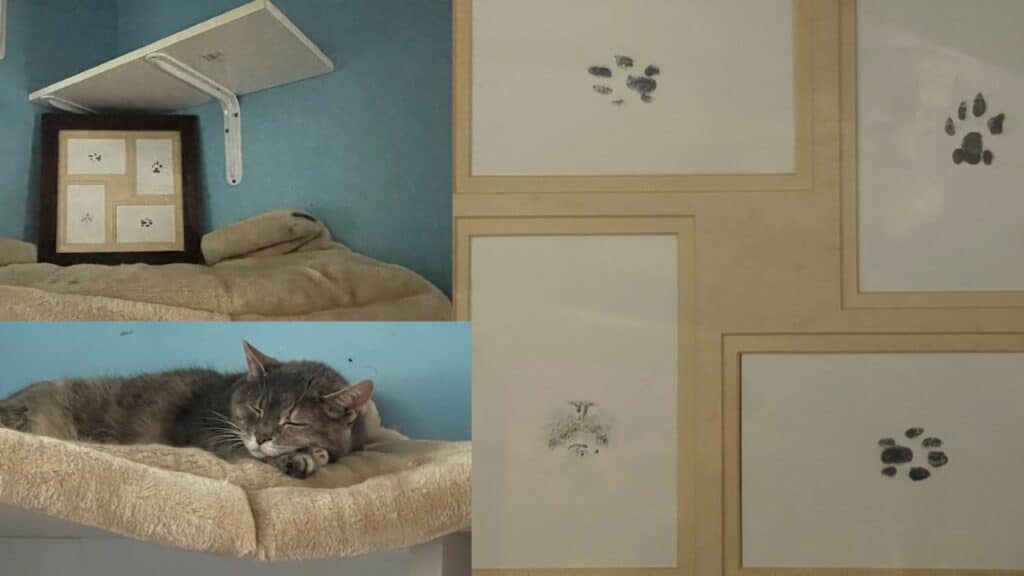
After Violet passed, a veterinary assistant took paw prints (all of the same paw) and one of her noses. I’ve never had this before with our previous cats that have passed.
My husband put them into a frame, which we have placed by one of Violet’s favorite sleeping spots.
Read Next:
- How to Know When to Put Your Cat Down
- Grieving the Loss of a Cat from the Heart of a Cat Lady
- Tips for Taking Your Cat to the Emergency Vet

Heidi Bender is the writer and founder of the Joy of Cats. She enjoys sharing cat information and providing helpful cat tips. She considers herself a cat lady and currently cares for seven cats.
Awe, Heidi, I’m so sorry. She sounded like such a sweet girl.
I love the paw prints. What a wonderful memory.
I’m so very sorry for your loss Heidi. Violet was a beautiful girl who had many wonderful years with you. I hope you can find some comfort in knowing that, as l know all so well the pain of unexpectedly (or expectedly for that matter) losing a beloved cat. As a believer in Jesus Christ, l truly believe l will see again, all the beautiful creations l was so blessed to have in my life. I pray the same for you. 💜